

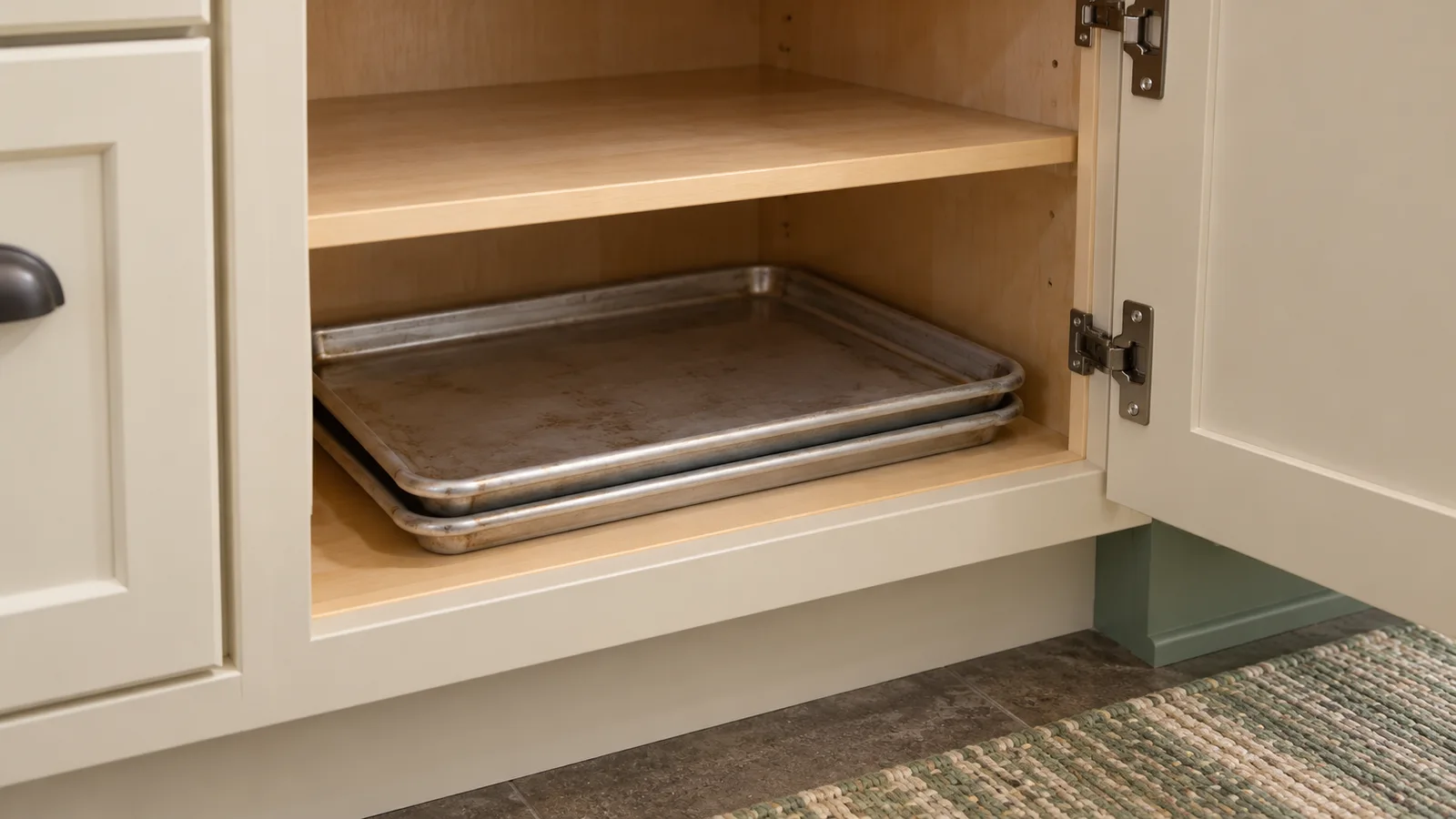
If your cabinet shelf is too low for an upright baking sheet, start with a small, flat stack of pans you use together. Check that you can pull out the pan you need without lifting a heavy pile or scraping the opening. A vertical rack is useful only when the cabinet opening, interior space, and loaded pan all fit.
The goal is a usable home for your baking sheets, not a cabinet that holds every tray you own. Before buying an organizer, separate the pans you reach for often from oversized pieces you use occasionally.
Find the piece that makes storage difficult
Empty the pan area and compare your baking sheets, roasting pans, cooling racks, and cutting boards. Which item stops the door from closing, catches on the shelf above, or traps everything underneath it?
One oversized sheet can determine the whole arrangement. Try setting it aside while you arrange the everyday pans. If the smaller group fits and is easy to use, the larger piece may need a different storage spot rather than a new organizer for the entire collection.
Keep the task separate from choosing more kitchen equipment. If you are deciding which pieces deserve cabinet space at all, see our guide to American kitchen essentials.
Measure the opening, the storage space, and the way out
Measure the pan at its widest points, including its rim and handles. Then check three different constraints:
- The opening: Measure the clear width and height the pan must pass through with the door open. Account for hinges, the cabinet frame, and any center divider.
- The space inside: Check usable depth, width, and height below the shelf. A cabinet can be larger inside than its doorway.
- The retrieval path: Try taking the pan in and out in the orientation you plan to use. Leave room for your hand and for any tilting the movement requires.
For upright storage, the pan’s upright height matters as well as its depth. Turning it onto a different edge may change which dimension points upward, but the other dimension still has to fit inside the cabinet. Do not assume a pan will fit just because a rack fits.
For flat storage, check the height of the complete stack and whether you can lift the top pan clear of the ones below it. An arrangement that fits only when the cabinet is empty will not help during dinner prep.
Choose the simplest arrangement that passes the fit check
| What you find | What to try first |
|---|---|
| Low shelf; everyday pans fit flat | Keep a small flat stack with the most-used pan easiest to reach. |
| Pans nest securely without forcing them | Group compatible pans; follow their care instructions for surface protection. |
| A different upright orientation fits | Test the loaded arrangement and removal path before choosing a divider. |
| One large pan prevents a workable layout | Find a separate suitable spot for that occasional-use piece. |
| The rack fits but the pan catches above it | Skip that rack; its empty dimensions do not establish loaded fit. |
| The cabinet is also your drying spot | Finish drying first, then return clean, dry items to storage. |
Use a small flat stack when height is the limiting factor
Put the pans you use most within easy reach. Avoid burying a baking sheet beneath unrelated heavy cookware. If removing one pan means holding up the rest of the stack with your other hand, reduce the group or move the obstructing piece.
Nesting can help when the pans are designed for it. For example, Nordic Ware describes its Prism Baking Sheet Set as three pans that nest together for storage. That is a claim about that set, not a guarantee that every collection of pans will nest safely.
Do not force rims together or assume bare surfaces can rub without damage. Follow the care instructions for your pans, especially when they have a coating. A protective layer also takes up space, so include it in the fit check if you use one.
Try upright storage only when the loaded setup fits
An upright divider can make individual pieces easier to reach, but it cannot create clearance above a low shelf. Test the actual pan orientation before ordering one.
As a specific example, the YouCopia StoreMore Bakeware Rack lists dimensions of 11.6 inches wide by 7.4 inches deep by 6.4 inches high with its dividers inserted. Those are the organizer’s dimensions. They do not tell you how tall your baking sheet will stand in it or whether you can remove it through your cabinet door.
Check the manufacturer’s setup instructions and the fit of each item. If you must lean a pan against the cabinet door or wedge it under the shelf, use another arrangement.
Give an oversized pan its own suitable home
A less-used sheet may fit flat on another accessible shelf or in a separate cabinet. Check the route in and out, and avoid balancing it on an unstable pile. Keep frequently used pans in the easiest location; occasional pieces do not need to dictate the everyday layout.
Do not solve the problem by leaving pans on a cooking surface or putting them away while hot. This storage plan does not require removing a fixed shelf, drilling, or changing the cabinet.
Keep drying separate from storage
A closed cabinet is the final storage destination, not a substitute for drying. The University of Minnesota Extension’s food-safety guidance specifically says to let cutting boards dry completely before putting them away and to store them in a clean, dry location.
If a cutting board shares the pan area, wait until it is dry rather than trapping it between baking sheets. For limited drying space, see how to dry dishes without counter space. If you use an over-sink cutting board, include its removal, drying, and storage route in the plan.
Do a retrieve-and-return check before buying anything
Use your current pans to test the proposed arrangement. Open the door normally, take out the pan you use most, and return it. Then try the least accessible piece. You should not have to unload the entire cabinet to use one baking sheet.
- Does each pan pass through the opening without scraping or forcing it?
- Does the shelf leave room for your hand and the required movement?
- Can you reach the everyday pan without lifting a difficult stack?
- Would a rack still leave enough space with the pans loaded?
- Is the oversized occasional-use piece better stored separately?
- Are the items and their storage area clean and dry before you put things away?
If a small flat stack works, stop there. Buy a divider only when you have identified a specific access problem it can solve and confirmed the loaded fit. A low shelf is a reason to choose a different arrangement, not a reason to squeeze in an organizer.
[…] baking sheets share the cabinet, assess them separately. The low-shelf baking sheet guide covers flat stacks and upright tray storage. A flat tray’s arrangement does not automatically […]