

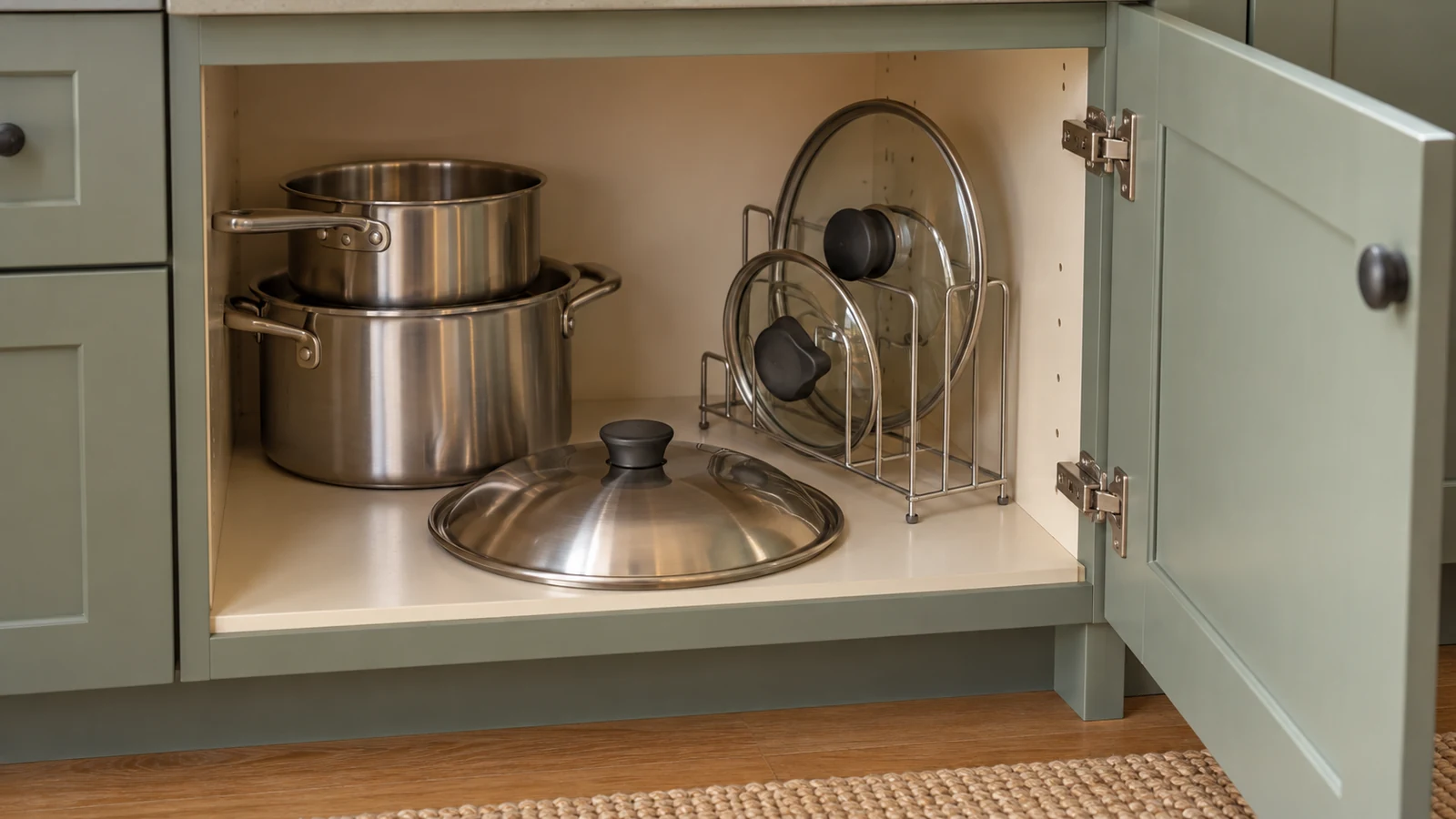
If a pot lid organizer will not work in your cabinet, find out what is colliding before buying a different one. The rack may fit while a domed lid, projecting knob, or crowded divider does not. Try keeping some lids with their pots and separating only the awkward ones. A useful arrangement lets you take out the lid you need, close the door, and return it without rearranging everything else.
Start with clean, dry cookware and the lids you actually use. This is a storage check for pot and pan lids, not a reason to replace your cookware or buy matching organizers.
Find the lid that disrupts the group
Take the lids out and match them to their pots. Set aside any lid whose matching cookware lives elsewhere. Then compare the remaining lids: a broad dome, long handle, or tall knob may need a different space from a flatter lid of the same diameter.
Try your current arrangement without the most awkward lid. If the others become easy to reach, you may have a one-lid problem rather than a cabinet-wide problem. Keep that lid in the plan, but do not assume every everyday lid needs the extra room it requires.
Also notice what makes you avoid the organizer. Does a lid fall sideways? Must you remove two others to grip its knob? Does the rack move when you pull one out? Those are different problems from a rack that is simply too wide for the shelf.
Decide which lids should stay with their pots
Keeping a lid on its matching pot can make the pair straightforward to find, provided the complete pair fits and you can handle each piece comfortably. It may be a poor use of space if it prevents otherwise compatible pots from nesting. Storing lids separately can free the pots, but only if the separate group is easier to use.
Try a mixed arrangement rather than committing every lid to one system. A frequently used saucepan might keep its lid, while the lids for nested pots occupy a nearby clear section of the shelf. An occasional-use oversized lid may belong with the pot you use it on, in another suitable location.
Do not assume turning a lid upside down is harmless for every pot. Le Creuset recommends storing its cookware with lids right-side up or separately; if lids must be inverted for stacking, it advises a protective layer between the lid and the pot rim. Follow the care guidance for your own cookware, including any protection or ventilation it requires. Do not force parts together to make a stack fit.
Check the space the loaded lids need
Use the actual lid in the orientation you intend to store it. Measure the widest part, then account for the dome and knob or handle. A diameter tells you only part of the story: the handle may project toward the door or into the neighboring lid’s space.
Look at these three points together:
- The cabinet opening: Can you pass the lid through with room to hold it, clear of hinges and the door frame?
- The divider space: Can the lid sit securely without its knob pushing against another lid or forcing the dividers apart?
- The closed-door space: Does the lid, handle, or rack project into the area the door occupies when shut?
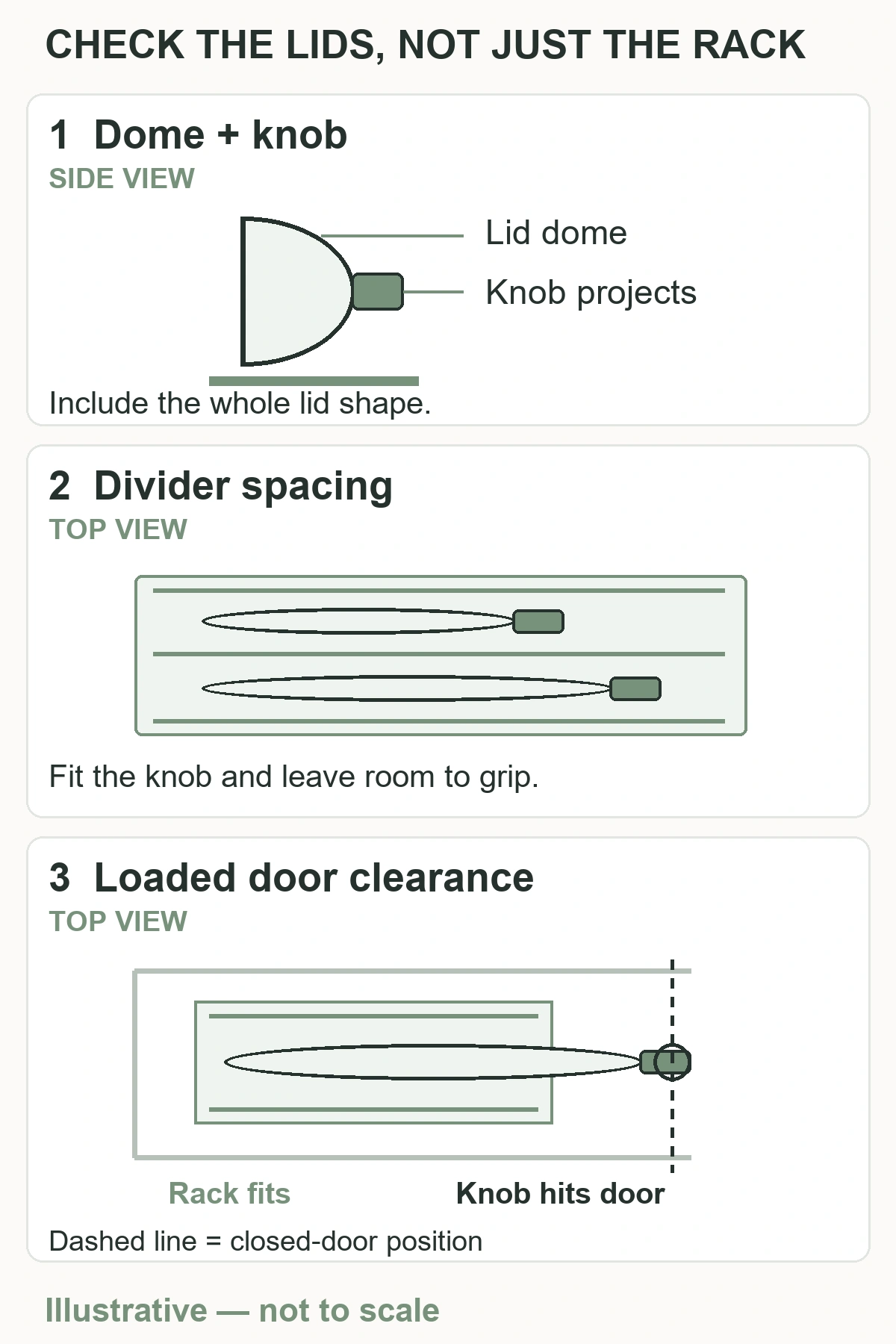
Close the door gently while watching for contact; stop rather than pushing an obstructing lid out of the way. Then take out the lid you use most and return it. Repeat with the least accessible one. A layout that fits while untouched may still be frustrating when your hand needs to reach between the lids.
If baking sheets share the cabinet, assess them separately. The low-shelf baking sheet guide covers flat stacks and upright tray storage. A flat tray’s arrangement does not automatically suit a domed lid with a knob.
Adjust the arrangement before replacing the rack
If your organizer has movable dividers, reposition them around the lids you own rather than filling every slot. Keep within its instructions; do not bend the wires or modify the base to force a fit.
For example, YouCopia’s StoreMore Adjustable Lid Holder measures 7.3 inches deep by 11.5 inches wide by 4.9 inches high with its dividers inserted. These are the holder’s dimensions, not the dimensions of your loaded arrangement. A lid can extend above the dividers or beyond the base.
YouCopia’s setup guidance calls for a flat surface and recommends positioning the dividers close enough to keep lids upright and easy to remove. Check both outcomes with your lids; a tight-looking row is not useful if you cannot grip one without disturbing the rest.
The IKEA US VARIERA pot lid organizer has an adjustable length and is intended for drawers or shelves. Adjustability gives you another arrangement to evaluate; it does not guarantee that a particular lid, handle, or cabinet door will clear.
If there is no rack, first try a small group in an existing suitable section of the cabinet. Lids that remain stable and individually accessible may not need one. Avoid an unsupported row that rolls or falls when you remove a piece.
| What is going wrong? | Try before buying |
|---|---|
| The knob catches the next lid | Reposition adjustable dividers as instructed, or move that lid out of the row. |
| The door touches a lid or handle | Change the loaded arrangement or choose another suitable spot; do not force the door. |
| One large lid takes most of the space | Test the everyday group without it, then give it a separate stable home. |
| Finding a lid requires unloading the shelf | Reduce the group or keep a frequently used lid with its pot. |
| The existing arrangement is stable and easy to use | Keep it. An organizer is optional. |
Give an occasional-use lid a different home
A stockpot lid used a few times a year does not have to sit beside a saucepan lid you use most nights. Try storing it with its matching pot on another suitable shelf, or in a separate stable space where you can retrieve it without a difficult overhead reach.
Do not solve a lid problem by making the pot harder to lift or by balancing a heavy lid on other cookware. Keep the location easy to remember, and check that the lid can come out without scraping or falling.
Keep permanent storage off your working counter. If lids repeatedly occupy the only place your cutting board fits, revisit the small-kitchen counter-space plan rather than adding another countertop rack.
Buy only for a problem you can name
A replacement organizer may be worthwhile when the lids need support or separation and your current setup cannot provide it. Before choosing one, write down the space available and the lid shapes it must hold. Compare its instructions and loaded access, not just an empty product photograph.
Skip the purchase when the lids already have a stable home, the door closes normally, and you can retrieve and return each everyday piece. You do not need to fill every available inch or make every lid face the same way. The right result is a lid you can find when the pot needs it.